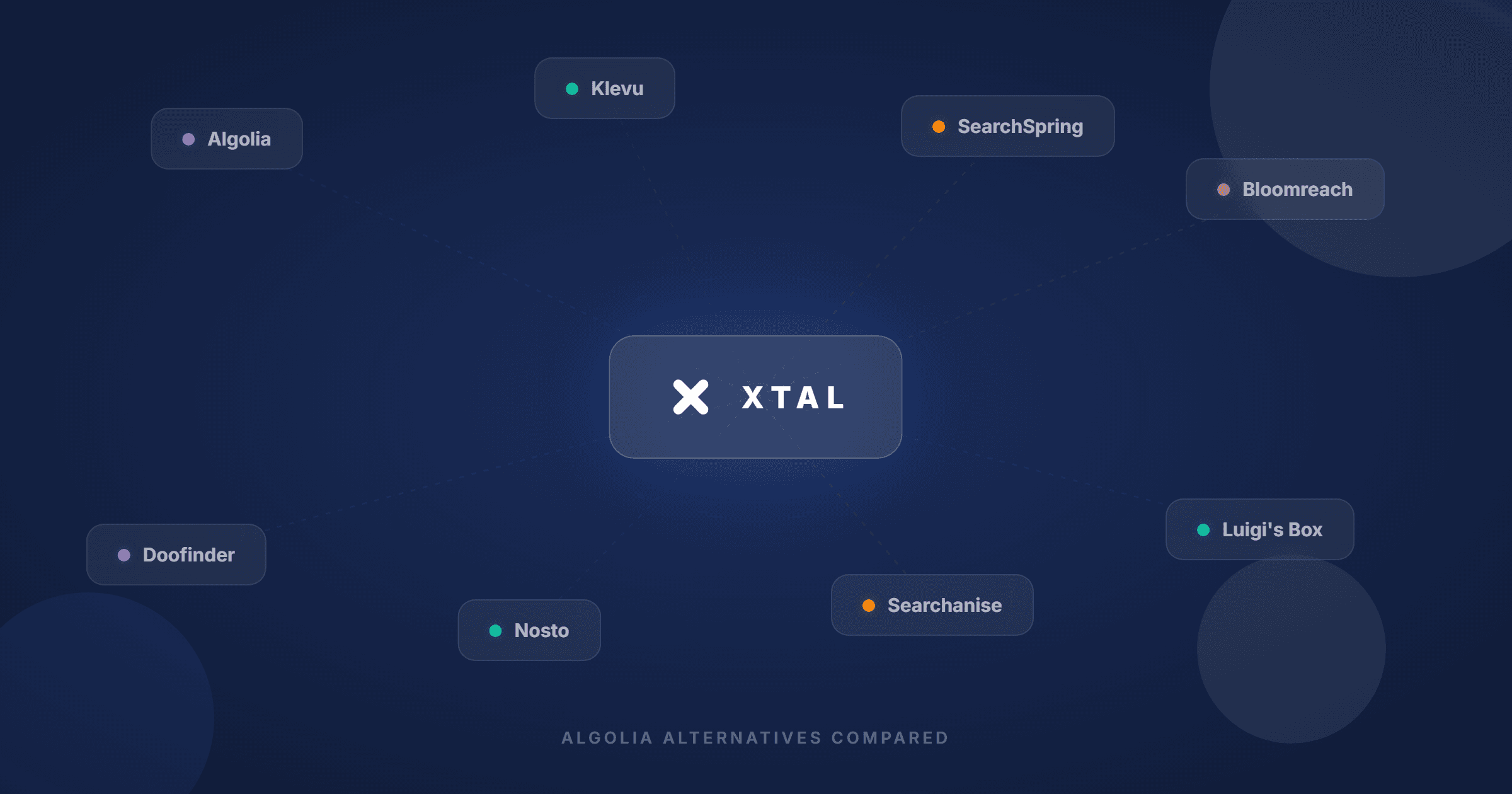
Algolia built its reputation on developer experience and raw indexing speed. For many teams, it was the default answer to "we need site search." But a lot has changed since then, and a growing number of ecommerce directors are running the numbers in 2026 and finding that the default no longer makes sense for them.
This guide covers the most viable algolia alternatives for ecommerce, with honest pros and cons for each. We'll look at what's driving merchants to evaluate competitors, walk through eight platforms in detail, and help you figure out which one fits your situation. We are not here to sell you anything in particular. XTAL is one of the options, and we'll give it the same treatment as the others.
If you've already narrowed your list, you might also want to read the three-way Klevu vs. Algolia vs. XTAL breakdown or the XTAL vs. Searchspring comparison for more focused head-to-heads.
Why Merchants Are Looking for Algolia Alternatives
The complaints fall into three consistent buckets.
1. The pricing wall hits faster than expected
Algolia charges on two dimensions simultaneously: records stored and search requests performed. The Grow tier includes 10,000 search requests per month, then charges $0.50 per additional 1,000 searches and $0.40 per additional 1,000 records. Semantic search through NeuralSearch lives in the Elevate tier, which requires an annual contract and has no published price. AI Ranking and AI Synonyms require Grow Plus, where additional searches cost $1.75 per 1,000. Algolia's startup program grants $10,000 in credits that are valid for 12 months from acceptance, after which unused credits expire.
2. Relevance tuning requires permanent engineering investment
Algolia gives you a powerful set of knobs (ranking criteria, custom ranking attributes, facet weights, synonyms, rules), but someone has to turn those knobs. For a mid-size ecommerce team without a dedicated search engineer, that overhead is real. The platform rewards teams who invest in it and punishes those who deploy it expecting self-optimization.
3. AI features are gated at the top tiers
Personalization and AI features like AI Synonyms and AI Ranking require Grow Plus, while semantic understanding (NeuralSearch) requires upgrading to Elevate. For teams evaluating vendors in 2026, this is a real gap: most modern alternatives include some form of semantic or intent-based search at lower price points than Algolia's AI tiers.
If any of these resonate, you're in the right place. Here's what the alternatives look like.
The 8 Best Algolia Alternatives for Ecommerce
1. Constructor
Best for: Large enterprise retailers who want search tightly coupled to conversion data.
Constructor is built entirely around the premise that search should optimize for business KPIs, not just relevance. It trains ranking models on your own conversion, click-through, and add-to-cart data, so the system learns what "good" means for your catalog specifically. Constructor lists Sephora as a customer and has published a case study about Backcountry's implementation.
Pros: Exceptionally strong conversion-focused ranking; solid merchandising controls; behavioral learning gets better over time; strong autosuggest and browse modules included.
Cons: Pricing is fully custom, enterprise-oriented, and unpublished. It may be out of reach for many mid-market teams. Implementation timelines are significant. It requires enough behavioral data to train on, so new stores or thin catalogs get limited benefit early.
Pricing: Custom quotes only. Generally targets larger retailers.
2. Bloomreach Discovery
Best for: Enterprise retailers with a broader CDP or email personalization need that can be bundled.
Bloomreach is a full commerce experience platform. Discovery (search + browse) is one module within a larger CDP, email, and content suite. The search product is strong, with real-time personalization and A/B testing built in. Many teams adopt it because they're already a Bloomreach customer for other reasons.
Pros: Deep personalization using cross-channel data; strong category page merchandising; proven at enterprise scale; good analytics.
Cons: Pricing is custom-enterprise and not accessible for most SMBs. The platform is large and takes time to configure. If you only need search, paying for the full Bloomreach suite may feel like overkill.
Pricing: Custom, enterprise-only. Contact Bloomreach for current pricing.
3. Klevu
Best for: Mid-market Shopify or Magento merchants who want AI search without enterprise commitment.
Klevu occupies an interesting middle tier: it has genuine AI and NLP capabilities (semantic search, multi-lingual support, intent recognition). In January 2025 Klevu merged with Searchspring and Intelligent Reach to form Athos Commerce, and platform pricing is now quoted through Athos. The one self-serve published price is the Klevu Shopify app, from $449/month. It integrates natively with Shopify and Magento. For more detail, see our Klevu comparison page or the three-way Klevu vs. Algolia vs. XTAL analysis.
Pros: Real semantic search included at non-enterprise pricing; solid Shopify integration; good predictive autocomplete; B2B search features available.
Cons: Reporting and analytics are less sophisticated than enterprise competitors. The merchandising dashboard can feel limited for teams with complex boosting needs. Some users report that initial setup requires developer help despite the "no-code" positioning.
Pricing: Quoted through Athos Commerce (Onsite Discovery, Offsite Discovery, and Complete Discovery plans with AI add-ons). The Klevu Shopify app is self-serve from $449/month.
4. Doofinder
Best for: Small to mid-size merchants who want a quick, affordable setup with minimal engineering.
Doofinder is the accessible end of the market. Basic plans start at $49/month and scale up to $349/month for the Advanced tier, while Enterprise pricing is custom. It offers a fast setup and handles typo tolerance, synonyms, and smart autocomplete without significant configuration. The tradeoff is control: its standard setup centers on typo tolerance, synonyms, autocomplete, and configured merchandising rather than an LLM-based retrieval pipeline.
Pros: Very fast setup; transparent, affordable pricing; handles the basics well; 15-day free trial on the Shopify app; Doofinder says exceeding a request limit does not interrupt service, though it's worth confirming how excess usage affects your next bill.
Cons: Limited merchandising control and weaker AI compared to pricier options; analytics can feel surface-level; may hit ceiling as catalog or traffic scales.
Pricing: $49/month (Basic), $149/month (Pro), $349/month (Advanced), custom Enterprise. Annual billing discounts available.
5. Nosto (Search & Discovery)
Best for: Merchants who want search bundled with personalization, recommendations, and UGC in one platform.
Nosto started as a personalization and recommendations engine and has since expanded into search. That heritage shows: the search product is tightly integrated with behavioral personalization across the entire site, and you get recommendations, search, A/B testing, and category merchandising as a bundle. Over 1,500 brands use it globally. Pricing is a custom license fee sized to your store's revenue and traffic, plus the modules you adopt, so cost grows with how much of the platform you use.
Pros: Strong personalization signals from day one; tight integration between search and recommendations; modular pricing so you pay only for the pieces you adopt; proven at scale across many verticals.
Cons: Pricing is quote-only and scales with revenue, traffic, and module count, making total cost hard to estimate up front; the search module is not as deep as standalone search-focused tools; best value only realized if you adopt multiple Nosto modules.
Pricing: Custom license fee based on store revenue and traffic, plus optional modules. Contact Nosto for a quote.
6. XTAL Search
Best for: Growing ecommerce teams who want AI-native search that matches their brand voice, with fast setup.
XTAL is built AI-first. The search pipeline runs two LLM stages around retrieval: augmenting queries with brand context before retrieval, then re-ranking results with a marketing lens after it. It understands semantic intent (not just keywords), handles aspect extraction automatically, and generates contextual explanations for why a result is relevant. It deploys as an embeddable JavaScript snippet that drops into Shopify, WooCommerce, or custom storefronts with no theme modifications.
Pros: AI-native from the ground up, not AI bolted onto keyword search; embeddable snippet makes it the easiest to deploy on custom storefronts; strong semantic relevance with no manual synonym management; conversational-style search built in.
Cons: Newer platform with a smaller customer base than the enterprise incumbents; fewer native integrations compared to Klevu or Bloomreach; reporting UI is still maturing.
Pricing: $0.10 per search, published at /pricing. Up to 50,000 searches per month, with volume pricing above that. Everything included, no setup fees, no annual contracts.
7. Searchanise
Best for: Small Shopify merchants looking for the cheapest alternative to algolia that still covers the basics.
Searchanise is one of the most affordable options in the market, with plans starting at $19/month on Shopify (a free plan covers stores with up to 25 products). It integrates directly into Shopify and recently added Shopify Markets support for location-aware search. The feature set covers instant search, smart autocomplete, product filtering, and basic AI recommendations, a clear step up from Shopify's native search without a big cost increase.
Pros: Very low starting price; quick Shopify installation; solid filtering capabilities that surpass Shopify native; location-aware search for international stores.
Cons: AI relevance is limited compared to mid-tier and enterprise options; less control over merchandising and boosting rules; more suited to SMBs than growing mid-market teams.
Pricing: From $19/month on Shopify; pricing varies by platform. See searchanise.io/pricing for current rates.
8. Luigi's Box
Best for: Mid-market European retailers who want a full product discovery suite with flexible integration options.
Luigi's Box is a European-headquartered product discovery platform covering search, recommendations, product listing pages, and a shopping assistant. It offers two integration paths: self-service (no-code + API + platform plugins) or a managed custom integration. Pricing scales with usage and the number of modules in use. The platform includes a 30-day free trial.
Pros: Full suite covering search, browse, and recommendations; flexible integration paths; strong analytics built in; good typo and synonym handling out of the box.
Cons: Less brand recognition in US markets compared to alternatives; pricing is not publicly listed, requiring a sales call for most teams.
Pricing: Custom, usage-based. Free 30-day trial available.
Feature Comparison
Not sure which platform is right for you?
Start by understanding where your current search falls short. Our free grader scores your store across 8 search quality dimensions in under 2 minutes — so you can walk into any vendor conversation knowing exactly what you need to fix.
Run the diagnosticPicking the Right Shortlist for Your Situation
The eight platforms above span a wide range of price, complexity, and capability. Here's how to narrow the field quickly based on your constraints:
- Budget under $100/month: Searchanise or Doofinder. Both outperform native platform search immediately with minimal setup.
- Mid-market ($5M–$50M revenue) wanting real AI: Klevu and XTAL. For a detailed breakdown of how they differ, see the Klevu vs. Algolia vs. XTAL comparison.
- Enterprise ($50M+ revenue) with a search team: Constructor or Bloomreach. Algolia at Elevate tier remains competitive here.
- Bundled personalization across the full site: Nosto.
- Considering Searchspring? That comparison deserves its own treatment; see the XTAL vs. Searchspring breakdown or the Searchspring comparison page.
- Want a direct Algolia head-to-head: The Algolia comparison page covers that in depth.
Why XTAL Takes a Different Approach
Most search platforms started with keyword indexing and added AI afterward: a re-ranking layer here, a semantic model there. The AI is grafted on. XTAL's pipeline was designed the other way around: large language model reasoning sits at the center of every search request, understanding the user's actual intent before retrieval happens, and then applying a marketing lens to re-rank results against your brand's goals.
In practice, you don't manually curate synonym dictionaries, you don't write boosting rules for every edge case, and you don't need a dedicated search engineer to maintain relevance over time. The LLM handles the linguistic complexity; you handle the business strategy.
The other notable differentiator is the embeddable snippet model. XTAL deploys as a <script> tag that intercepts your existing search input and renders results in an overlay — no theme modifications, no platform lock-in. For teams running custom storefronts, headless builds, or multi-site setups, this matters. Whether that advantage holds as competitors release their own lightweight embed options is still an open question.
The Bottom Line
Algolia is a capable platform, but it was built for a world where "search" meant fast keyword matching with developer-tunable ranking. In 2026, the market has moved toward intent-based, AI-driven discovery, and several of these alternatives deliver that at lower total cost or lower engineering overhead than Algolia's AI tiers.
The right choice depends on your scale, platform, and whether you have in-house search engineering capacity. No vendor comparison can replace testing with your own catalog and your own queries. Whichever direction you go, start by understanding your current baseline. A vendor promising a "2x improvement" means nothing if you don't know what you're improving from. You can audit your search quality for free in about two minutes, and the report is useful regardless of which platform you end up choosing.
Get more like this
AI-powered ecommerce search insights, delivered monthly.
XTAL Team
Search Platform Analysis
Continue Reading
Klevu vs Algolia vs XTAL: Honest Three-Way Comparison for Mid-Size Ecommerce
Updated July 2026: a three-way comparison of Klevu (now Athos Commerce), Algolia, and XTAL Search for mid-size ecommerce stores. Features, pricing, setup, and AI capabilities.
XTAL vs Searchspring: Which Search Platform Is Right for Your Store?
An honest comparison of XTAL Search and Searchspring (now Athos Commerce) — what changed after the merger, feature differences, and who should switch.
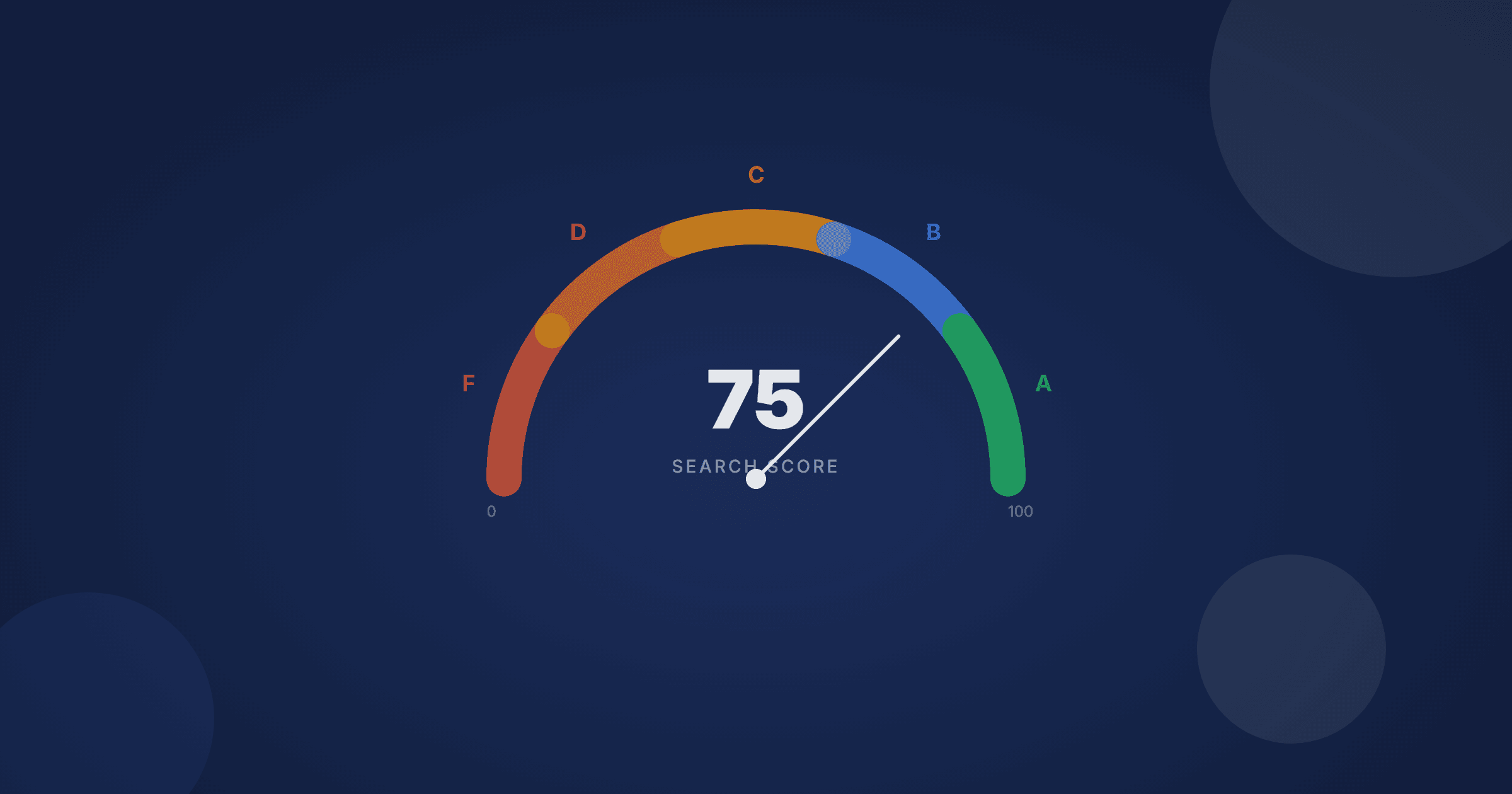
What Is a Good Ecommerce Search Score?
Learn how to objectively measure your store's search quality across 8 dimensions, what scores mean, and how to identify where your search is falling short.